


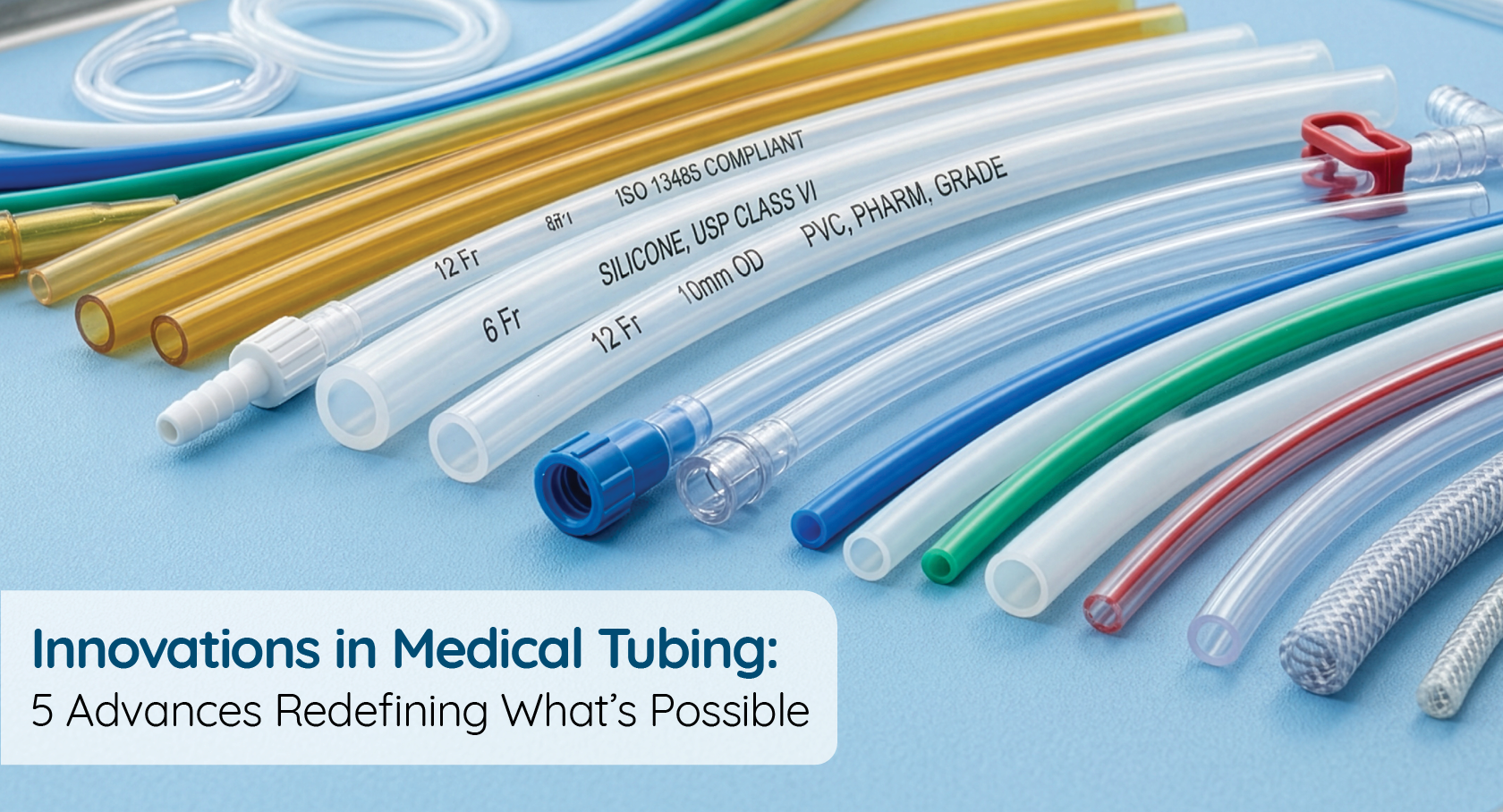
Medical tubing doesn’t get much attention outside the manufacturing floor, but it’s quietly become one of the more active innovation zones in device development. The medical tubing market is projected to grow from $13.40 billion in 2026 to $19.64 billion by 2031, a 7.9% compound annual growth rate, driven largely by demand for minimally invasive procedures and increasingly sophisticated catheter-based devices.
That growth isn’t coming from doing the same extrusion process at greater volume. It’s coming from real advances in materials, precision, and process control. Here are six of them worth understanding, whether you’re specifying tubing for a new device or evaluating whether your current supplier is keeping pace.
1. Coextrusion and Multi-Layer Construction
Coextrusion, combining two or more materials into a single extruded tube, each layer contributing a different property, is now the largest structural segment of the medical tubing market. A typical example: an inner layer chosen for lubricity, a middle layer for adhesion, and an outer layer chosen for bondability to a balloon or hub. Rather than compromising on one material that does everything adequately, coextrusion lets each layer do one thing well, and the possible combinations span a wide range of material pairings depending on what the application calls for.
2. Micro-Extrusion and Tighter Tolerances
As devices move deeper into smaller and more delicate anatomy, neurovascular and pediatric applications especially, tubing tolerances have gotten correspondingly tighter. Some manufacturers in this space are now extruding to tolerances as fine as ±0.0005 inches on both inner and outer diameter for select projects. The industry benchmark is roughly 1% of ID/OD (often closer to ±0.001 inches in practice), with wall thicknesses thin enough to matter in microns rather than just thousandths of an inch.
Tighter isn’t automatically better: it adds cost, and the right tolerance depends on how the device is used and what the application actually requires, not on defaulting to the tightest spec possible.
3. Smart and Antimicrobial Tubing
A newer category of tubing is starting to do more than transport fluid or house a component, at least in concept. Some raw materials on the market claim antimicrobial properties, of interest for applications where infection risk is a design priority, though adoption across the industry remains limited rather than standard practice, and antimicrobial coatings are typically applied as a separate, secondary process rather than built into the extrusion itself.
“Smart” tubing (concepts exploring embedded sensing to track pressure, flow, or temperature along the length of a device) is arguably more a device-level trend than a tubing manufacturing one. Where it exists, sensing is added on rather than inherent to the extruded tube.
Both are worth watching, but neither is mainstream yet.
4. Bioresorbable and PFAS-Alternative Materials
Two material shifts are happening in parallel. Bioresorbable polymers, materials designed to safely break down in the body over time, are expanding beyond their original use in sutures and stents into broader device applications. Separately, the industry is actively researching alternatives to PFAS-containing fluoropolymers, driven by tightening environmental and regulatory scrutiny of that chemical class.
Neither of these is a wholesale replacement for established materials like FEP or PTFE today, but both are worth watching for OEMs planning multi-year device roadmaps.
5. Continuous Inline Measurement
Extrusion quality control used to mean periodic sampling and offline measurement. It increasingly means continuous inline measurement throughout the run: laser-based systems tracking dimensions like ID, OD, and wall thickness in real time, rather than relying on spot checks after the fact. That shift is enabling tighter process control and faster detection of drift before it produces scrap.
What This Means for Choosing a Tubing Partner
Not every device needs micro-extrusion tolerances or coextruded multi-layer construction. But every device benefits from a tubing supplier who understands where the field is moving, rather than one still quoting the same process they were running five years ago. The right questions to ask a prospective partner: what’s the tightest tolerance they’ve actually held in production, what materials have they worked with beyond the standard catalog, and how do they validate a process rather than just inspect the output.
Related Reading: How Extrusion Technology Is Used in Medical Device Manufacturing


